


The Ultimate Guide to HYROX: Everything You Need to Know in 2026
HYROX has quickly become one of the most talked-about fitness competitions around the world — and now, Malaysian athletes have an even bigger reason to pay attention.
For the first time, HYROX is coming to Malaysia. AirAsia HYROX Kuala Lumpur will take place from 10–13 December 2026, giving runners, gym-goers, CrossFitters, functional fitness enthusiasts and everyday athletes the opportunity to experience the global fitness race right here in Kuala Lumpur.
But what exactly is HYROX? How difficult is it? What do you need to train? And what should you know before taking on your first race?
Here is everything you need to know about HYROX — from the race format and workout stations to training, pacing, nutrition and recovery.
What Is HYROX?
HYROX is an indoor fitness race that combines running with functional workout stations.
The format is simple:
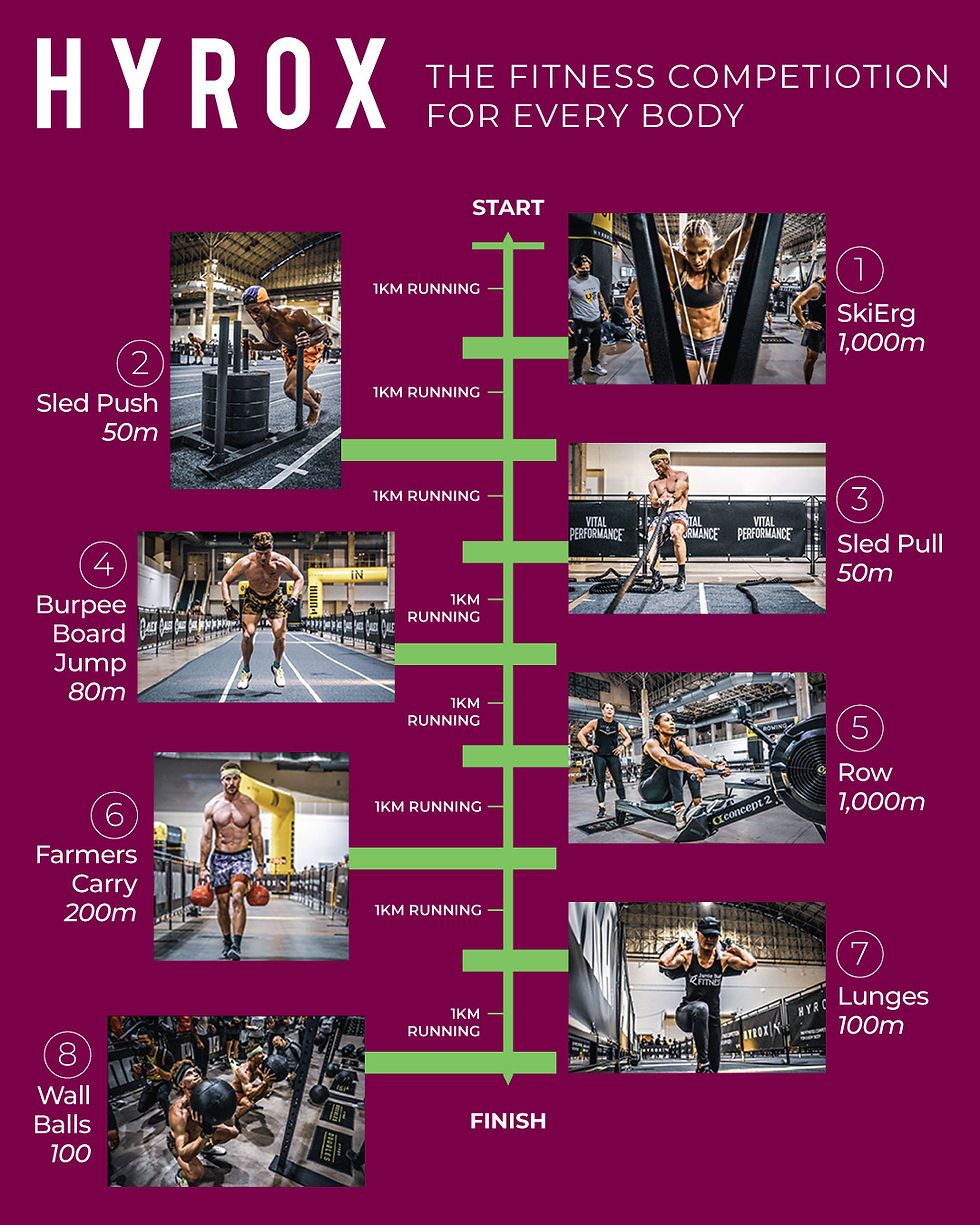
1 km run → 1 workout station → 1 km run → 1 workout station — repeated eight times.
That means every HYROX race consists of:
8 km of running
8 functional workout stations
The running and workout stations are completed in a fixed sequence, making HYROX different from a traditional road race or a standalone strength competition.
The result is a race that tests more than just how fast you can run or how much weight you can lift. You need to be able to run efficiently, perform functional movements under fatigue and manage your effort throughout the entire race.
What Are the 8 HYROX Stations?
Every standard HYROX race follows the same sequence.
1. 1 km Run → SkiErg
The SkiErg requires you to use your upper body, core and legs to generate power while maintaining a controlled rhythm.
The challenge is not simply completing the distance. You also need to manage your effort so that you can transition into the next 1 km run.
2. 1 km Run → Sled Push
The sled push is one of the most recognisable HYROX movements.
It requires lower-body strength and full-body effort, but technique matters too. Pushing too aggressively can leave your legs heavily fatigued before the next run.
3. 1 km Run → Sled Pull
The sled pull demands a combination of pulling strength, grip and body control.
After another 1 km run, maintaining efficient technique becomes increasingly important.
4. 1 km Run → Burpee Broad Jumps
This station combines repeated burpees with forward jumps.
It is a highly demanding movement because it repeatedly raises your heart rate while requiring you to move your body through a large range of motion.
5. 1 km Run → Row
The rowing station tests both endurance and technique.
A controlled stroke rate and efficient rowing technique can help you avoid unnecessarily burning through your energy before the next run.
6. 1 km Run → Farmers Carry
The Farmers Carry involves carrying weights over the prescribed distance.
Grip strength, posture and core stability all come into play, particularly after several kilometres of running and functional work.
7. 1 km Run → Sandbag Lunges
Sandbag lunges place a significant demand on the legs and lower body.
By this point in the race, fatigue is already accumulating, making movement efficiency especially important.
8. 1 km Run → Wall Balls
The final workout station is Wall Balls.
After completing seven previous runs and seven workout stations, finishing the required repetitions while maintaining good movement standards can be one of the biggest challenges of the race.
Once the final Wall Balls are completed, you have finished HYROX.
How Hard Is HYROX?
HYROX is challenging because it combines endurance and functional strength continuously.
You are not completing all your running first and then moving on to the workouts. Instead, you repeatedly switch between running and functional exercise.
This means the way you perform one station can affect how you feel during the next run.
For example, pushing too hard on the sled may leave your legs fatigued. That fatigue then carries into your next 1 km run.
This is why HYROX is not simply about being a fast runner or a strong gym-goer.
You need to be able to run, lift, move and manage fatigue repeatedly.
HYROX's own sports science work highlights the importance of the interaction between running, strength, technique, fatigue and pacing.
Do You Need to Be an Elite Athlete to Do HYROX?
No.
One of the reasons HYROX has attracted such a broad following is that it is designed as a mass-participation fitness competition, with different divisions to suit different levels of experience.
However, "accessible" does not mean "easy".
Even the Open division is a demanding endurance and functional fitness event, so preparation is important.
The good news is that you do not need to start as an elite athlete.
You can build your fitness progressively and train specifically for the demands of the race.
HYROX Divisions Explained
If you are considering entering HYROX, understanding the divisions is one of the first things you should do.
Open
The Open division uses the standard HYROX weights and is generally the starting point for many first-time racers.
It is challenging, but designed to be accessible to a broad range of athletes.
Pro
The Pro division uses heavier weights and is intended for more experienced competitors looking for a greater challenge.
If this is your first HYROX, Open is generally the more appropriate starting point unless you already have a strong background in functional fitness and endurance racing.
Doubles
In Doubles, two athletes complete the race together.
Both athletes run the 1 km sections together, while the workout stations can be divided between the pair according to the applicable rules.
This makes Doubles an attractive option if you want to experience HYROX with a training partner, friend or teammate.
Relay
Relay allows four people to form a team.
Each team member completes two 1 km runs and two workout stations.
It is a great way to experience the HYROX format as a group without having one person complete the entire race.
HYROX currently offers Open, Pro, Doubles and Relay formats, with specific divisions and rules applying to each category.
How Should You Train for HYROX?
The biggest mistake you can make is training only one side of the sport.
Running more will not automatically make you a better HYROX athlete.
Likewise, becoming stronger in the gym does not necessarily mean you will perform well across eight kilometres of running.
Your training should develop several areas.
1. Build Your Running Fitness
Running accounts for a significant proportion of the total race.
You will run 1 km eight times, so your training should prepare you to run efficiently even when your legs are already tired.
Include a combination of:
Easy runs
Tempo runs
Intervals
1 km repeats
Longer aerobic runs
You should also practise running after strength or functional work.
For example:
1 km run → sled push → 1 km run
This is much more specific to HYROX than simply running 5 km on a treadmill.
2. Build Functional Strength
Your strength training should reflect the movements you will encounter during the race.
Prioritise movements such as:
Squats
Lunges
Deadlifts
Carries
Pulling movements
Pushing movements
Core exercises
Sled work
Wall Balls
Rowing
SkiErg
You do not need to turn every gym session into a full HYROX simulation.
Instead, build a strong foundation first, then gradually introduce more race-specific sessions.
3. Train Under Fatigue
One of the defining features of HYROX is that you rarely perform a movement when completely fresh.
You run before every workout station.
That means your training should sometimes recreate this experience.
For example:
1 km run → 20 Wall Balls → 1 km run → Farmers Carry → 1 km run
The objective is not always to go as fast as possible.
You are teaching your body to maintain good technique and controlled effort while fatigued.
4. Learn the Movement Standards
HYROX is a competition, not simply a workout.
That means completing the required distance, repetitions and movement standards matters.
Take the time to learn how each movement should be performed.
Practise the movements under controlled conditions before trying to perform them at race pace.
Good technique can also help you use your energy more efficiently.
5. Don't Start Too Fast
This is one of the most common mistakes first-time HYROX athletes make.
The atmosphere on race day can be intense. The music is loud, the crowd is excited and everyone around you is moving.
It can be very tempting to run the first kilometre at your best 1 km pace.
But HYROX is an endurance event.
You still have seven more runs and seven more workout stations to complete.
HYROX itself recommends finding your rhythm, controlling your effort and avoiding an excessively fast start.
A good HYROX strategy is not simply about going fast.
It is about going fast enough that you can keep going.
6. Practise Your Transitions
Every time you finish a workout station, you have to start running again.
Those transitions matter.
Practise moving efficiently from:
Run → station → run
Avoid unnecessary standing around, excessive equipment adjustments or wasting energy between movements.
Over eight rounds, small inefficiencies can add up.
How Long Should You Train for HYROX?
There is no single preparation period that works for everyone.
Your ideal training time depends on your current fitness, running experience, strength, previous race experience and target.
Someone who already runs regularly and has a strong functional fitness background may need less preparation than someone starting from scratch.
As a general principle, give yourself enough time to progressively build:
Running fitness + strength + movement technique + race-specific conditioning.
Do not try to cram everything into the final few weeks.
Consistency is more valuable than simply adding more training.
What Should You Eat Before HYROX?
Nutrition is another part of race preparation.
Your overall diet should support your training and recovery, with adequate carbohydrates, protein, fluids and other nutrients based on your individual needs.
On race day, avoid experimenting with completely new foods or supplements.
Practise your nutrition strategy during training first.
The same applies to beetroot juice and dietary nitrate.
Beetroot Juice and Nitrate for HYROX
Dietary nitrate is one performance nutrition strategy that has been studied in endurance and high-intensity exercise.
Beetroot is naturally rich in nitrate. In the body, nitrate can contribute to the nitric oxide pathway, which plays a role in blood flow and muscle function.
The Australian Institute of Sport classifies dietary nitrate/beetroot juice as a Group A performance supplement, meaning there is strong scientific evidence for its use in specific sporting situations when used according to appropriate protocols.
Research protocols commonly use approximately 350–500 mg of nitrate 2–3 hours before exercise. The AIS also notes that a period of daily supplementation before competition may be another strategy in some circumstances.
Importantly, the amount of nitrate in ordinary beetroot products can vary considerably.
This is why athletes looking to use nitrate strategically should pay attention to the actual nitrate content, rather than simply choosing any beetroot juice.
Why a Standardised Nitrate Dose Matters
Not all beetroot products provide the same amount of nitrate.
The nitrate content of vegetables can vary depending on factors including growing conditions, climate, soil and time since harvest. The AIS notes that concentrated beetroot products can provide a more reliable targeted dose than relying on ordinary dietary sources.
For athletes, this makes a clearly stated nitrate content useful when planning supplementation.
Beet It Sport Nitrate 400 provides a standardised 400 mg nitrate dose per shot, making it convenient for athletes who want to incorporate dietary nitrate into a structured performance nutrition strategy.
It should be viewed as part of an overall race plan — not as a replacement for training, nutrition, hydration or recovery.
And as with any supplement, it is sensible to test your strategy during training before race day.
When Should You Take Beet It Sport Before HYROX?
A commonly researched strategy is to consume approximately 350–500 mg nitrate around 2–3 hours before exercise.
For athletes using Beet It Sport Nitrate 400, the 400 mg nitrate content fits within this commonly studied range.
However, individual responses can vary.
If you are trying nitrate supplementation for the first time, don't wait until race morning.
Practise your timing and tolerance during training first.
The AIS also advises athletes to avoid antibacterial mouthwash around nitrate supplementation because it can interfere with the oral bacteria involved in nitrate conversion.
Don't Forget Recovery
Finishing HYROX is only part of the process.
Recovery helps you prepare for your next training session and adapt to the demands you have placed on your body.
Your recovery basics should include:
Sleep
Quality sleep supports physical and mental recovery and should be a priority during both training and competition periods.
Nutrition
Refuel with adequate carbohydrates and protein to support recovery, particularly after demanding sessions.
Hydration
Replace fluids according to your individual needs and the conditions in which you trained or raced.
Rest
Not every training session needs to be hard.
Allowing your body enough time to recover is part of effective training.
For athletes looking at nutrition strategies beyond the race itself, recovery products such as Beet It Regen Cherry +, which combines sour cherry and beet concentrate, can be considered as part of a broader recovery routine.
HYROX Malaysia: What You Need to Know
For Malaysian athletes, HYROX is no longer something you need to travel overseas to experience.
AirAsia HYROX Kuala Lumpur will take place from 10–13 December 2026.
The event marks HYROX's first arrival in Malaysia and will bring the fitness race format to Kuala Lumpur.
Participants can choose from solo Open and Pro categories, Doubles and Relay formats.
If you are considering signing up, now is the time to start preparing.
Don't wait until race week to find out what 8 km of running combined with eight functional stations feels like.
Your HYROX Preparation Checklist
Before race day, make sure you have:
☐ Built a consistent running base ☐ Practised 1 km running intervals ☐ Developed functional strength ☐ Practised all eight HYROX movements ☐ Learned the relevant movement standards ☐ Practised running under fatigue ☐ Worked on pacing ☐ Practised transitions ☐ Tested your race-day nutrition ☐ Tested any supplements during training ☐ Prioritised sleep and recovery ☐ Familiarised yourself with your race division and rules
Ready for HYROX?
HYROX is not about being the strongest person in the gym or the fastest person on the track.
It is about bringing together strength, endurance, movement efficiency and pacing — and being able to repeat that effort eight times.
Whether you are preparing for your first HYROX, planning to race with a friend or chasing a new personal best, the fundamentals remain the same:
Train smart. Pace yourself. Fuel well. Recover properly.
And when you step onto the HYROX race floor, remember that every kilometre and every station is part of the same challenge.
Your HYROX starts long before race day.